
In the summer of 2025, the world's only outdoor, six-degree-of-freedom earthquake simulator — located at UC San Diego's Englekirk Structural Engineering Center — subjected a full-scale, 10-story cold-formed steel (CFS) building to 18 simulated earthquakes of increasing intensity, followed by live fire compartment tests. The experiment, known as CFS10, was the culmination of more than a decade of component research and system-level testing, and the result of a large-scale collaboration across universities, government agencies, and industry partners.
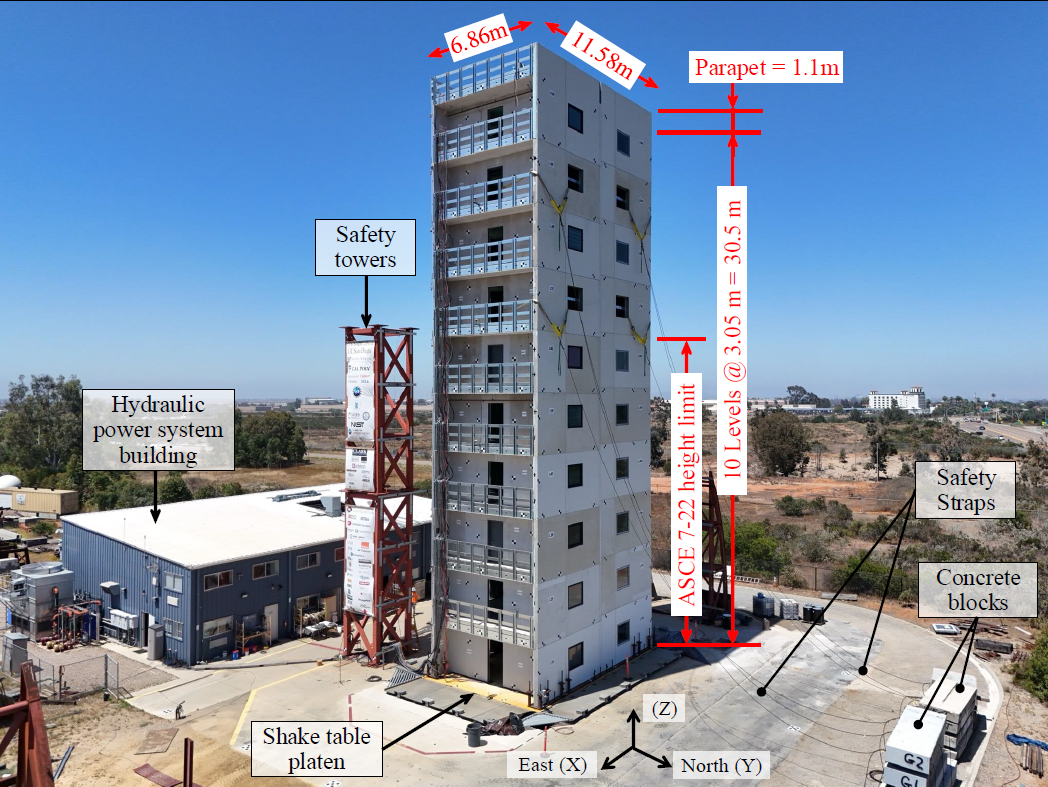
At its core, CFS10 is about changing what is legally buildable. Current U.S. building codes under ASCE 7 cap cold-formed steel buildings at six stories — approximately 65 feet. The CFS10 test building stands 31.6 meters (103 feet, 9 inches), deliberately designed beyond that limit, with the goal of generating the real-world data needed to support safe, evidence-based expansion of those code boundaries.
"We are able to test new ideas and push the boundaries of what we're doing in structural design and construction. Cold-formed steel is a great example of a promising lightweight, sustainable, and highly durable material, ideal for use in regions of high seismic hazard and for construction of tall buildings."— Professor Tara Hutchinson, Lead Researcher, CFS10
Why Cold-Formed Steel?
Cold-formed steel is shaped at room temperature into structural members — studs, joists, tracks — used widely in commercial and residential construction. Its properties make it particularly attractive for seismic design: CFS buildings weigh approximately one-third to one-quarter that of reinforced concrete buildings and about half to one-third that of structural steel buildings. Lower weight means lower seismic forces — one of the most direct levers for improving earthquake performance.
Beyond its structural efficiency, CFS offers a range of environmental and durability benefits. It is fully recyclable and typically manufactured from recycled steel. It is non-combustible, corrosion resistant, and dimensionally stable. CFS construction generates little waste and readily meets modern energy codes including LEED standards. Its redundant structural framing also provides reserve load paths — even if one element is compromised, others in the system can absorb the demand, reducing the risk of catastrophic collapse.
What Was Tested — and How
The CFS10 building was constructed directly on the shake table's platen and outfitted with more than 1,000 sensors monitoring acceleration, displacement, and local strains throughout the structure. The earthquake test series replicated recorded ground motions from major historical events, including the 1994 Northridge earthquake and the 1989 Loma Prieta earthquake, at increasing intensity levels — ultimately including motions at and above what design engineers are currently required to consider.
The building performed well under the seismic loading. "Despite 18 earthquake tests of increasing intensity — including three very large at and above what design engineers must consider in designing a building — the load-bearing structural system retained its integrity," said Professor Hutchinson following the test series. The seismically resilient stair system, designed with drift-compatible connections to move with the building rather than resist it, remained functional throughout — a critical finding for post-earthquake building access and evacuation.
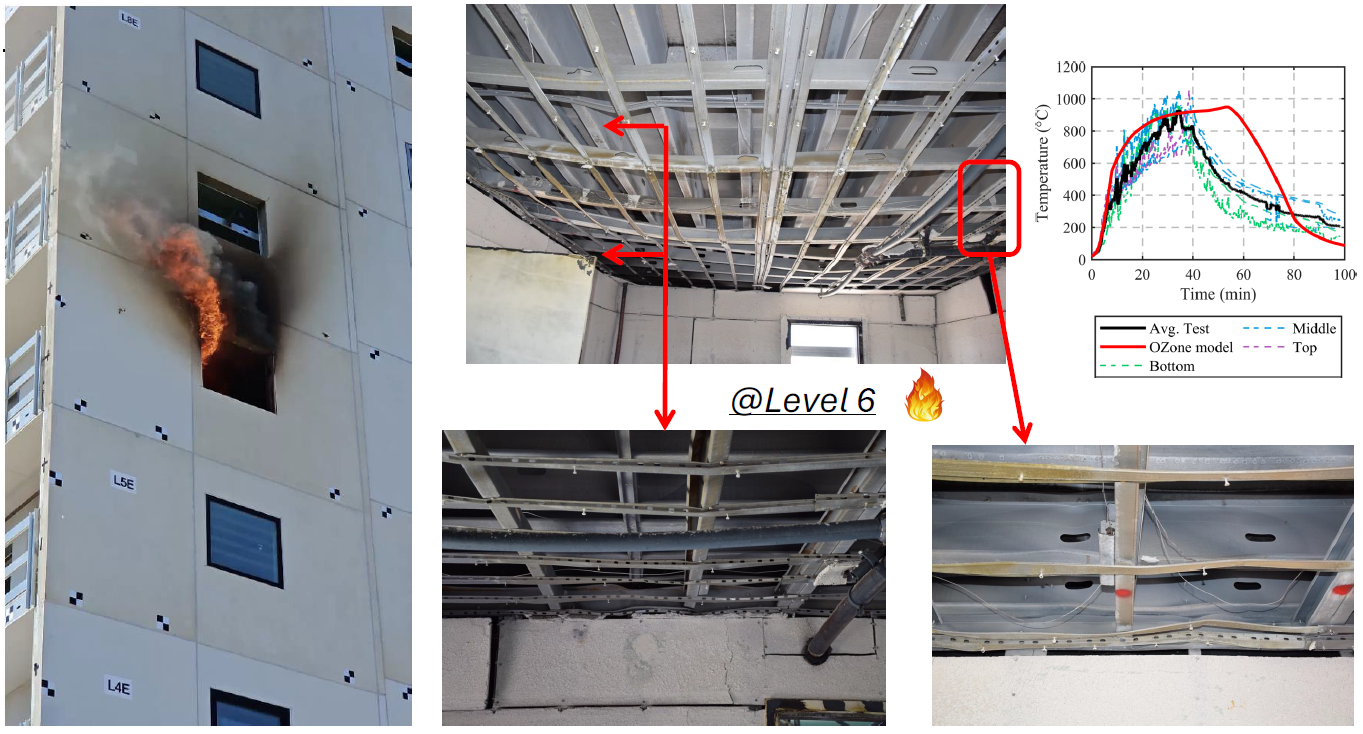
Following the earthquake tests, the research team conducted two live-fire, high-intensity compartment tests led by Professor Richard Emberley at Cal Poly San Luis Obispo. These "fire-following-earthquake" scenarios examined how temperature, smoke, and particulates spread through seismically damaged compartments — a real-world post-disaster condition that codes and emergency response protocols must account for.
|
Construction methods Stick framing, 2D panelization, and 3D volumetric modular — all within one building |
Structural innovations Steel sheet sheathed shear walls, hollow steel section columns, built-up chord stud packs |
|
Shake table capability 6-DOF: full 3D motion including roll, pitch, and yaw — upgraded in 2022 with $17M NSF funding |
Multi-hazard testing 18 seismic tests at increasing intensity plus two live-fire compartment tests |
One Building, Three Construction Methods
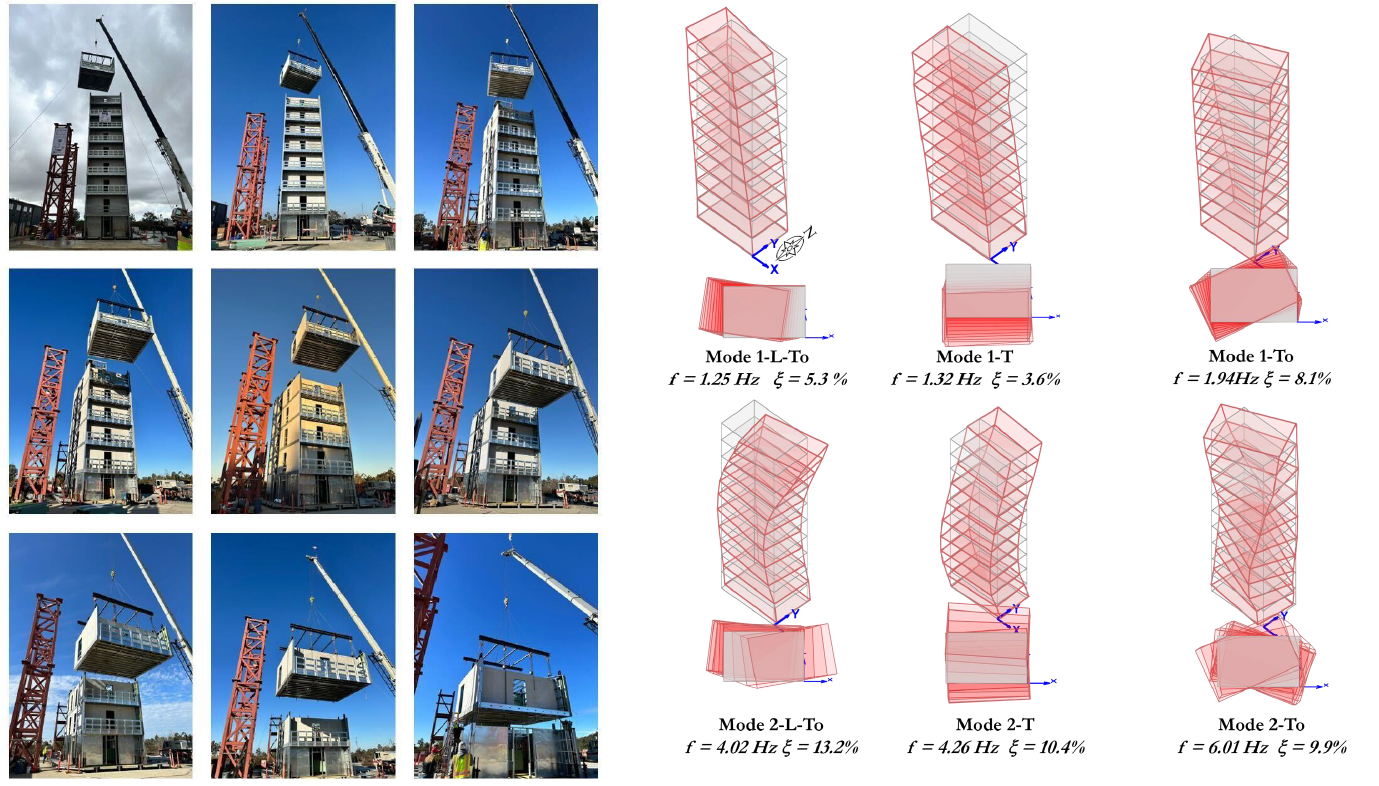
A distinctive feature of CFS10 was its deliberate integration of three construction methods within a single specimen. The first level was stick-framed on-site in the traditional manner. Upper floors used prefabricated 2D panels. And a portion of the building was constructed using 3D volumetric modular units — essentially factory-built room-sized assemblies stacked in place. This allowed researchers to directly compare the structural performance and construction efficiency of each approach under identical loading conditions.
Modular construction carries significant practical appeal: lower material waste, reduced carbon footprint, better energy efficiency through tighter building envelopes, and faster on-site assembly. The CFS10 experiment offered a rare controlled setting to quantify those differences and examine whether performance varied by construction method under seismic stress.
A Decade in the Making
CFS-NEES
2-story cold-formed steel system-level test program — the first in the series.
CFS-HUD
6-story cold-formed steel building test, conducted in partnership with the U.S. Department of Housing and Urban Development.
2022
$17M NSF-funded upgrade to the UC San Diego shake table adds full 6-DOF motion capability.
June–July 2025
CFS10: full-scale 10-story building subjected to 18 earthquake simulations and two live-fire tests on the LHPOST6.
2025 onward
Data analysis, model validation, and code development underway. Dataset to be publicly released on the NHERI DesignSafe Data Depot.
Collaboration and Funding
CFS10 is a collaboration between UC San Diego, Johns Hopkins University, and Cal Poly San Luis Obispo, with co-lead Professor Ben Schafer of Johns Hopkins and fire testing led by Professor Richard Emberley at Cal Poly. The project is funded by NSF awards #1663569 and #1663348, with additional support from the U.S. Department of Housing and Urban Development, the California Seismic Safety Commission, the California Office of Emergency Services, and the National Institute of Standards and Technology. Significant industry contributions came from ClarkDietrich, Clark Construction, Standard Drywall, Mid-Rise Modular, Bapko Metal, Grabber Fastening, the American Iron and Steel Institute, and the Steel Framing Industry Association, among others.
Learn More
cfs10.ucsd.edu — Project homepage
nheri.ucsd.edu/live-cams — NHERI @ UC San Diego live cameras