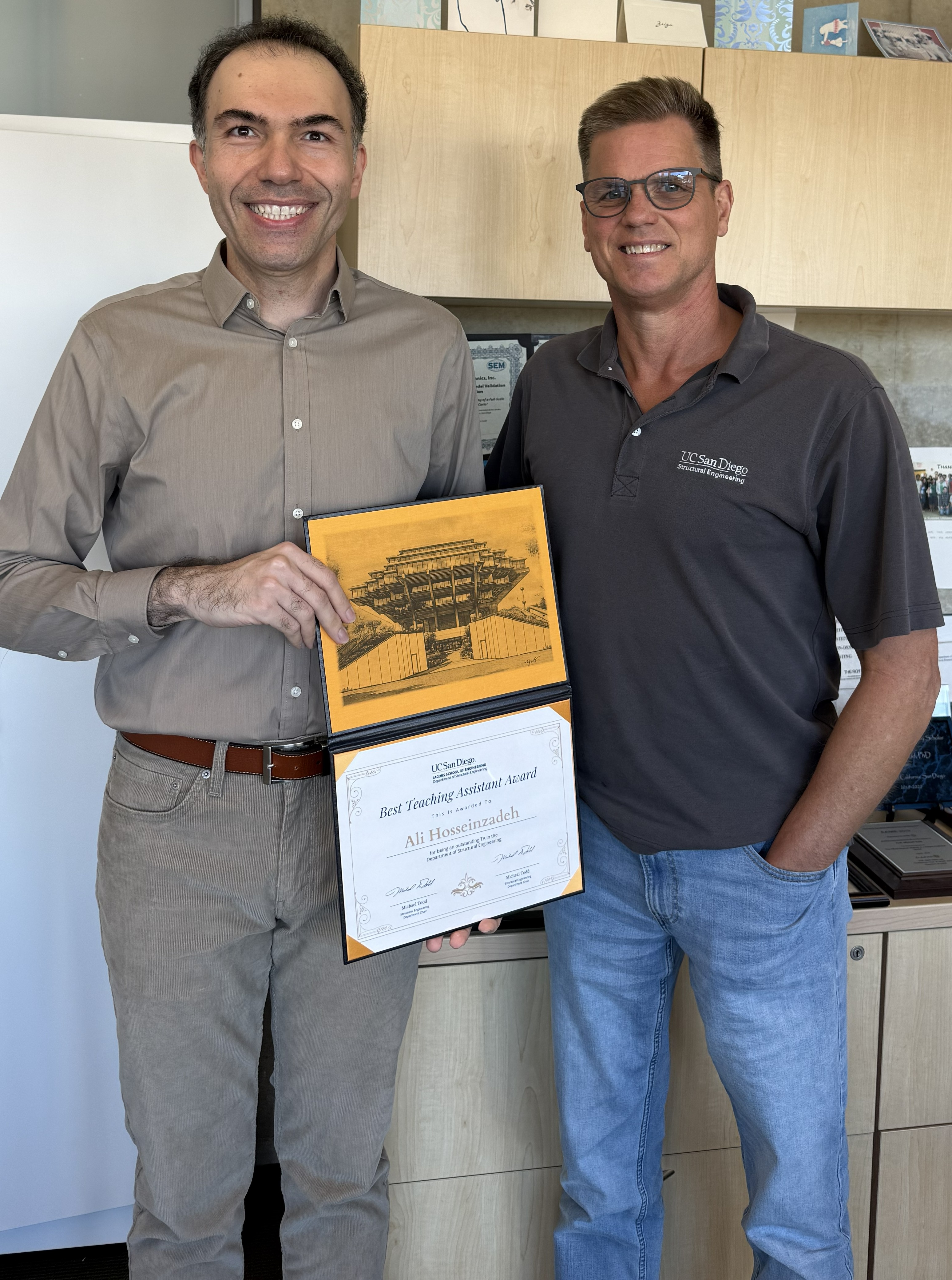
Ali Zare Hosseinzadeh, a PhD candidate in Structural Engineering at UC San Diego working with Distinguished Professor Francesco Lanza di Scalea, has received the Outstanding Teaching Assistant Award from the Department of Structural Engineering. The award recognizes Ali's sustained contributions to teaching across multiple undergraduate and graduate courses — supporting large classes and diverse groups of students while helping deliver core material in structural engineering and mechanics.
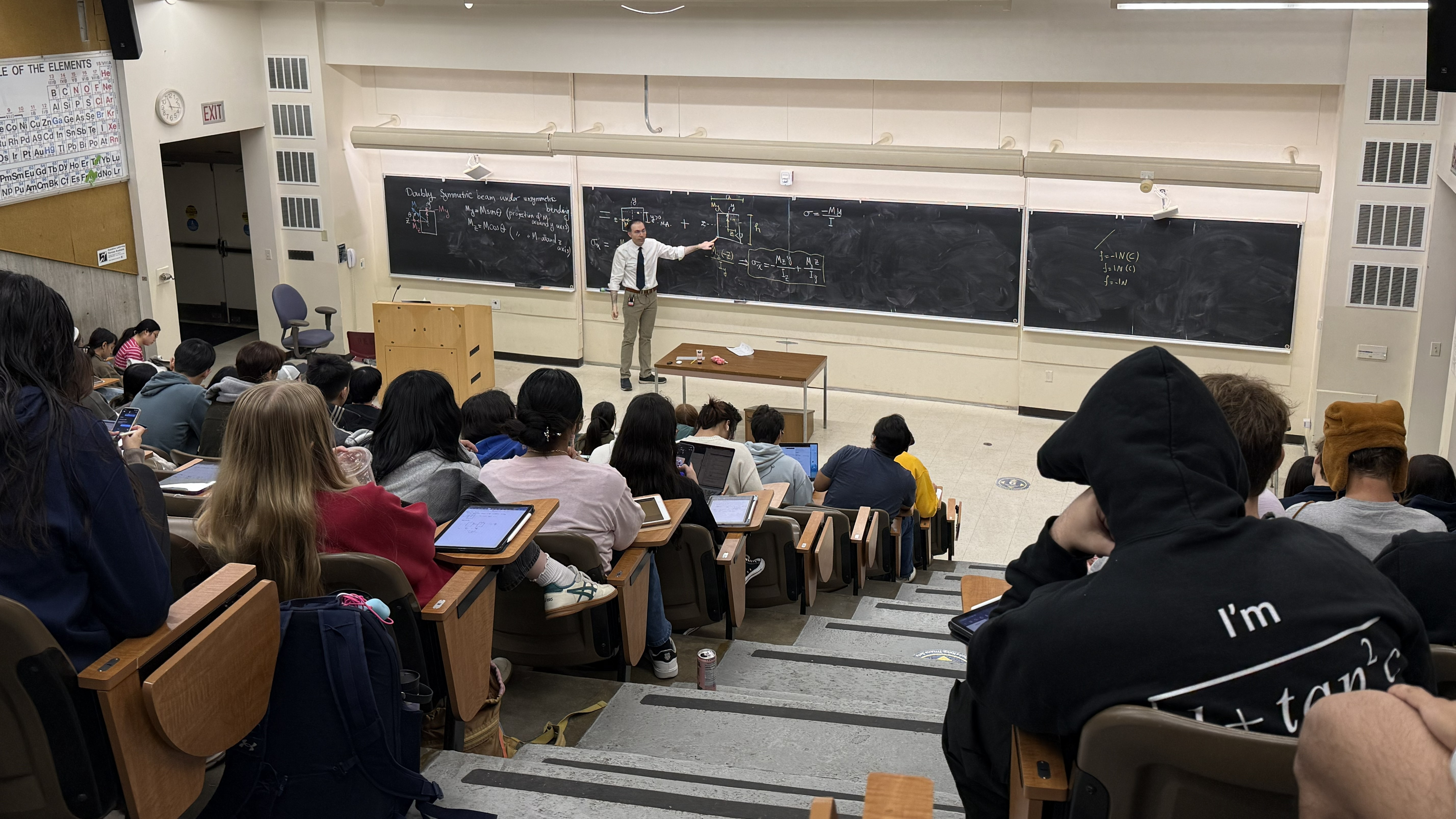
Ali's approach to the classroom is rooted in clarity and structure. Rather than presenting formulas as endpoints, he guides students through the reasoning that produces them — building the kind of engineering intuition that makes it possible to tackle unfamiliar problems with confidence. His sessions emphasize active discussion and invite students to engage directly with the mechanics of structural systems, connecting theory to the practical problem-solving they will carry into their careers.
A Philosophy of Understanding
At the heart of Ali's teaching is a belief that students learn best when they understand not just what the answer is, but why the formulation works the way it does. He works closely with students to bridge the gap between the abstract language of structural mechanics and the physical intuition that brings it to life — using carefully structured explanations and interactive learning to help students build confidence in approaching challenging analytical problems.
This approach has made an impression across large, diverse classes where the range of student backgrounds and preparation can vary considerably. His ability to meet students where they are and bring them toward deeper understanding is precisely the quality the department's award recognizes.
Research in Nondestructive Evaluation
Alongside his teaching, Ali conducts research in nondestructive evaluation and structural health monitoring of engineering systems — work focused on detecting damage and assessing the condition of structures without taking them out of service. It is a field with direct implications for the safety and longevity of civil and mechanical infrastructure, and one that sits at the intersection of experimental methods, signal processing, and structural mechanics.
Together, his contributions to teaching and research reflect a commitment to both dimensions of the department's academic mission: advancing knowledge at the frontier of the discipline while ensuring that the next generation of structural engineers is well prepared to carry that knowledge forward.