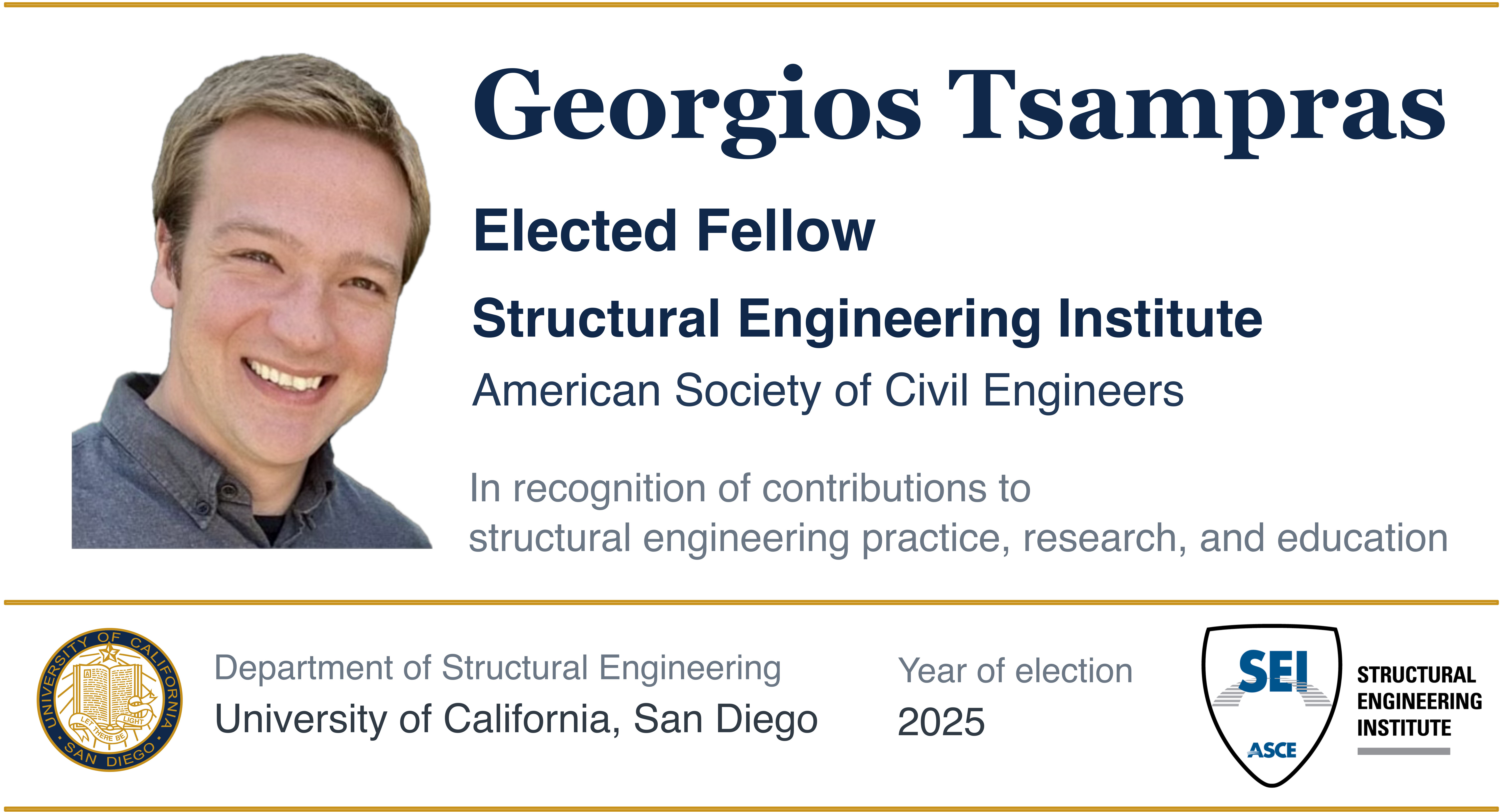
Professor Georgios Tsampras has been elected a Fellow of the Structural Engineering Institute (SEI) of the American Society of Civil Engineers (ASCE) — the institute's highest membership grade, reserved for those recognized as leaders and mentors in the structural engineering profession. The distinction, awarded to a select group within SEI's more than 30,000 members, reflects sustained contributions across research, practice, and professional service spanning over a decade.
Candidates for the SEI Fellow grade must be licensed professional engineers, actively involved SEI members, nominated by an SEI organizational entity, and must demonstrate at least ten years of responsible charge in structural engineering — typically accrued following licensure. All applications are reviewed by the SEI Fellow Review Committee and require unanimous assent for advancement. For Professor Tsampras, the path to this recognition winds through three continents, two industry sectors, and a career built around the principle that engineering challenges are best solved from first principles.
"This recognition reflects the impact of the work I have contributed to academia and to civil and aerospace structural engineering practice, including seismic resilience, the development of force limiting connection systems, and the training of students who contribute to the profession." — Professor Georgios Tsampras
A Career Built on Fundamentals
Professor Tsampras's engineering career began in Greece, where he pursued graduate studies in seismic design at the University of Patras from 2009 to 2011. Working part time at an engineering office while completing his MS thesis under Professor Nikitas Bazeos, he earned his professional engineering license in Greece before moving to the United States for doctoral study.
At Lehigh University, under the supervision of Professor Richard Sause, he completed his PhD between 2011 and 2016. That training — grounded in integrated experimental and numerical research, careful observation, and rigorous technical communication — established the standards that continue to shape his work today.
What followed was an unusually broad period of industry practice. From 2016 to 2020, Professor Tsampras worked on the structural evaluation of safety-related nuclear infrastructure at Simpson Gumpertz and Heger, and contributed to damage tolerance and life qualification analyses for aerospace structures at SpaceX — including the Falcon 9 and Falcon Heavy launch vehicle systems. That range of experience, he notes, sharpened his focus on solving demanding engineering problems using methods grounded in fundamental principles and supported by rigorous quality control.
In 2020, he joined UC San Diego, where his research group develops low-damage, high-performance, earthquake-resilient building systems through integrated experimental, computational, design, and advanced manufacturing methods.
2009 – 2011
MS in seismic design of structures, University of Patras, Greece. Professional engineering licensure in Greece.
2011 – 2016
PhD, Lehigh University, under Professor Richard Sause. Integrated experimental and numerical research methods.
2016 – 2020
Structural evaluation of nuclear infrastructure at Simpson Gumpertz and Heger; damage tolerance analyses for Falcon 9 and Falcon Heavy at SpaceX.
2020 – Present
Faculty, UC San Diego. Research in earthquake-resilient building systems; structural engineering education and mentorship.
2025
Elected SEI Fellow, Structural Engineering Institute, ASCE.
Research, Practice, and Service
The SEI Fellow recognition draws on contributions across all three dimensions of the profession. In research, Professor Tsampras has worked on force limiting connection systems and resilience-based design approaches for buildings — technical areas with direct implications for how structures perform under seismic loading. In practice, his work has spanned the structural safety of nuclear facilities and the life qualification of launch vehicles. In service, he has contributed to ASCE SEI through technical committee work, editorial activity, and student mentoring.
His ASCE involvement has evolved steadily since he joined in 2013, moving from student attendee and presenter at the Structures Congress to active service roles. He has served as secretary for ASCE SEI Technical Council Task Group 2 and for the ASCE SEI Special Project on the effects of climate change on life cycle performance of structures and infrastructure systems — a project led by Professors Fabio Biondini, Zoubir Lounis, and Michel Ghosn.
In His Own Words
On what the SEI Fellow recognition means:
"Being elected an ASCE SEI Fellow recognizes sustained contributions to structural engineering through research, education, and service. It reflects the impact of the work I have contributed to academia and to civil and aerospace structural engineering practice, including seismic resilience, the development of force limiting connection systems, and the training of students who contribute to the profession."
On his professional journey and industry experience:
"This experience helped me focus on solving challenging engineering problems using methods grounded in fundamental principles and supported by rigorous quality control procedures."
On what drives his current work at UC San Diego:
"In 2020, I joined UC San Diego, where I develop research on low damage, high performance, earthquake resilient building systems through integrated experimental, computational, design, and advanced manufacturing methods. In parallel, I educate structural engineering students and contribute to the profession through research dissemination and training of engineers."
A Model for the Next Generation
What makes Professor Tsampras's career distinctive is its deliberate breadth. He moved between academia and some of the most technically demanding environments in industry — nuclear safety, commercial spaceflight — before returning to the university to train the next generation of structural engineers. The SEI Fellow recognition, in that sense, reflects not just a body of publications or a record of service, but a professional identity built across sectors and sustained over time.
For students entering the profession today, his trajectory offers a useful reminder: deep engagement with industry, far from a detour, can be what sharpens the questions that define a research career.